Monday, February 2, 2009

Reflecting on a mission


This weekend I sat down to read a statement that is found in every building on campus and should hold some weight for the future and direction of the College. The Aquinas College mission statement, though profound and thoroughly pumped with otherwise nebulous value language, exhibits questionable combinations of mission words and vagacious phraseology.

Value language as exhibited in mission statements may be one of the only vocabularies that everyone can understand and, at the same time, interpret differently.

Aquinas College’s mission statement juxtaposes not-so-similar ideas such as “liberal arts education” and “Catholic Dominican tradition” with “career preparation.” I have never seen career- preparation/vocational training among the standards of liberal arts education, viz. learning how to think, how to critique, how to see things as a whole, etc. Stanley Fish, critic of this sort of utilitarian vocational training, notes the necessary inutility of higher education.

“Higher education, properly understood, is distinguished by the absence of a direct and designed relationship between its activities and measurable effects in the world.” By this he seems to imply that students of higher education should not find their reason for learning in anything beyond their continual edification, and though this view is challenged, it is the view of classical education that reigned for centuries and the understanding endorsed by Aristotle, Immanuel Kant, Max Weber, and others.

Further, the noted scholar of higher education John Henry Newman wrote, “[The purpose of a liberal arts education is to] open the mind, to correct it, to refine it, to enable it to know, and to digest, master, rule, and use its knowledge, to give it power over its own faculties, application, flexibility, method, critical exactness, sagacity, resource, address, [and] eloquent expression…” Nowhere does it hint at fostering job skills.

Though such an utterly deflationary understanding of education may be out of touch with the realities and needs of college students today, it may still raise questions as to where a university’s primary focus should land between activism, education and career preparation.

The mission statement continues to note how Aquinas College “fosters a commitment to lifelong learning dedicated to the pursuit of truth and the common good.” I cannot concretely see how this commitment is fostered, and although I like the sound of it, I think I am more concerned about the commitment to learning for the time when I am attending the College.

Another single word that has been inflated and twisted anyone’s wishes is “inclusive.” What does it mean to be an “inclusive educational community?” Does it mean that everyone is welcome to attend Aquinas College (ignoring the fact that welcome is equally vague)? Does it mean that I have to invite everyone to my study sessions? Does it suggest that I need to accept everyone’s ideas? Does it protect ideas from critique and evaluation?

If I could be so forward, I feel like the mission statement is missing something quite important, something each person should have at least considered when applying to any college. Where could the phrase “committed to offering the best education possible” fit? Though I understand that College administrations need to take numerous factors into account when making decisions, shouldn’t the quality of education be a prime consideration?

Unless I am dense to expect something so obvious, why aren’t we concerned about fostering these commitments?

Acknowledging that critiquing a text doesn’t exactly amount to a conclusive statment about Aquinas College’s state of affairs, I see how this really doesn’t matter. If high school seniors want a Catholic-liberal arts-vocational/career oriented college, then the administrative powers has the responsibility to balance fiscally running the College with providing the best education possible. If a college wishes to continue to exist it must offer a product that people want to buy.

Thursday, November 20, 2008

Opting into the future


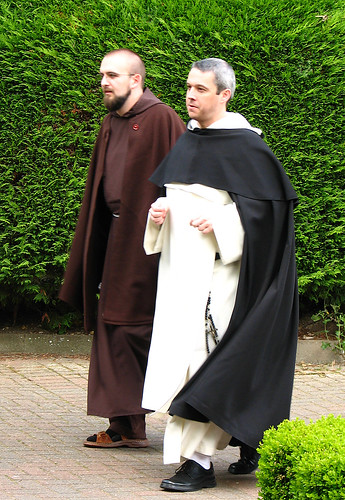
Usually around Homecoming each year, for some reason I come in contact with an Aquinas Yearbook. I know, an Aquinas yearbook itself sounds foreign enough, but the novelty of the experience is the certain atmosphere found between the covers.Some time ago, Aquinas was a different place. The pages evidence classrooms filled with students taught by Dominican friars clad in white robes tied with rosaries. In each yearbook, certain significance is given to a yearly crowning of the Marian shrine. And graduation was celebrated in the second floor of the Fieldhouse, now known as Bukowski Chapel. Student life was different in many respects.

Though certainly things change with growth and the past usually gives way to the future, it is hard to ignore the somewhat atmospheric change which is occurring at Aquinas, and numerous other Catholic colleges throughout the United States, due to the dwindling amount of vowed religious belonging to orders such as the Dominicans, Franciscans and Jesuits.

These numbers reached their apex in the early 1960s and began to fall through the completion of the Second Vatican Council in 1965.

The College’s question of identity sitting ominously in the distance is what will happen with Aquinas College if the Marywood Dominicans cease to provide a religious presence to the campus? Can the Dominican tradition be preserved without Dominicans? And if so, how?

Although it is possible to support the traditions and values of an absent religious order, it seems that the efforts of a Catholic College would be futile if they are not supported directly by the Church, whether through the diocese or religious order. To be Catholic means to be supported and to support; there’s nothing Catholic about a rogue college.

Other Catholic colleges and universities are addressing similar issues. Georgetown University’s resident religious community has shrunk from 100 in 1966 to 60 this year. Searching collegiate newspapers, it is easy to find editorials asking, “Are we Catholic?” As Scott Appleby, a professor of history from the University of Notre Dame, noted, there seems to be “a crisis looming within American Catholic higher education.”

Following the dramatic pause, also insisted by Appleby, he prescribes three steps to regain the beginnings of hope for American Catholic administrators. Appleby recommends that institutional leaders “stay the course, continue to adjust the course and be good to one another.”

I am so glad he didn’t recommend trying to single-handedly fix the vocations problem, overturning the Church’s mandate of celibacy to increase the number of priests or simply ignoring the impending situation. Realistically if we have any type of faith, most of the answers to these problems will not come from our end of the spiritual correspondence.

Along the lines of staying and adjusting the course, we must know what our course headings currently point toward. Aquinas supports a thriving Campus Ministry Department, philosophy and theology majors, a Catholic studies minor, theology as a general education requirement, a Catholic Studies Club and on-campus liturgies.

These facts evidence Aquinas’ recognition and appreciation of the Catholic tradition, and numerous other campus clubs and activities confirm the student support for such values.

Then, how can the College solidify and empower existing programs and activities to enrich the greater Aquinas community, whether Catholic or not? I humbly suggest perhaps filling the room for growth in the philosophy and/or theology departments and strongly considering the importance of a resident chaplain. I’m sure that my peers have other suggestions.

Whatever the answer happens to be, our idea of a Catholic University cannot merely cater to Catholics, and similarly the Catholic Church must enter, though sometimes apprehensively, the outside world. To paraphrase Donald W. Wuerl Archbishop of Washington, the truly Catholic university should work to nurture respect in its interactions, while in its actions remain faithful to its heritage and traditions.

I doubt the answer to the problem will involve either building walls or relativizing distinctions, but I hope (whatever it is) we can bring everyone along.

(Published in Nov. 19 edition of The Saint)

Wednesday, November 12, 2008

Open Question

I'd like to hold a modest experiment. If people participate, this could be interesting.

What are the challenges that a Christian faces in relating to this world, this time in history?

Please, comment at your leisure.

Wednesday, October 1, 2008

Voting Catholic, frustrated


For Catholics, the process of voting should not be simple, and it's even worse if you're voting absentee. Casting a vote is simple-just punching a card. Leading up to the card, however, the voting process asks much of the Catholic. (Although this is ideally both, this term means more broadly "catholically minded," instead of sacramentally formed.)

It would be easier if the Church or the Pope would tell everyone which candidate gets the "Catholic vote." Thankfully, this is not how the Church works.

The process would be simpler if Catholics were able to be simple-issue voters. Perhaps, a single issue could consume the whole of their political and ethical decision, irrespective of the totality of their choice. On this subject, the Vatican's Congregation of the Doctrine of the Faith writes, "a political commitment to a single isolated aspect of the Church's social doctrine does not exhaust one's responsibility towards the common good."

An even easier situation would be if Catholics could simply give the finger to the whole political establishment, saying, "You have done nothing for us; your game is not fair, and we want out."

Catholics can do none of the above. They are "bound to promote the true common good" through "civil authority and laws that uphold moral precepts for the common good," which should constitute an autonomous decision informed by rational scrutiny applied to possible choices. In other words, Catholics can neither hide in political idleness nor in ideaological closures to the reality of affairs.

From their point of view, no candidate seems good enough. In the Bush-Gore election, Gore was ahead by three percent with Catholics. Then in 2004, Bush led among Catholics by seven percent to Catholic John Kerry. Currently, McCain leads among white non-Hispanic Catholics 48 to 41 percent.

Simply put, the Church's teaching does not line up with either party. On one hand, the Church cherishes the right to life, especially unborn life. But also, the Church respects the dignity of the human person, the social implications to avoid war, the responsibility to help the poor and the regulation of working conditions, whether on a personal scale or to the economy as a whole. The Catholic should work for all these things and, when necessary, must seemingly choose one or the other.

Catholic morality says quite candidly, it is wrong to support a candidate or law which entail an intrinsic evil "opposed to the authentic good of persons" such as abortion, euthanasia, torture, racism and ignoring the "moral imperative to respond to the needs of our neighbors."

When both candidates support such a policy the Catholic "may decide to vote for the candidate deemed less likely to advance such a morally flawed position and more likely to pursue other authentic human goods." Whether Catholic voters realize it or not, most recent presidential elections fall into this category.

This is what makes Catholics want to write in their dog's name on the ballot. This is why politics seems like a badly formed game. To have to choose the rights of an unborn child over the rights of an innocent victim of an unjust war, is unfair, to say the least.

Not only does the power to participate in the formation of government implicate the Catholic in the direct effects of his or her choice, whether war or peace, prosperity or hardship, but the choice should come from an authentically formed auto-nomy (self-law) and should be an expression of a certain amount of wrestling with issues, candidates and God.

Catholics who vote should go to sleep on the Third of November with some sense of peace, knowing that their decision is neither uninformed nor narrowly informed by one issue. That peace, however, should not overshadow the clear dissonance which is evident when the idealist hope of faith enter the realm of politics.

Monday, August 25, 2008

A mentionable thought


It is a luxury of the academic world to be able to have "cocktail conversations" about life, love and other questions that usually, as Tennyson wrote, "rust unburnish'd" without timely buffing and rumination.

These big questions of a higher nature are not detached from the truth of our lives, our daily preoccupations and scurryings about. Rather these questions, these higher questions begin to augur into the foundation of each "Why?" or "How?".

A few days ago, a friend noted that for once he understood the lyrics to a popular song. I think many of us have had this experience. A popular song with catchy words gets lodged as a constant repeat in your head. The words pass by with the notes, but they don't go quite deep enough for you to think about them, to understand their meaning. Occasionally, however, a well-written phrase may fall between the superficial cracks in you mind, and the depth is astounding.

The particular phrase my friend noted was "live like today never happened before". So, together we considered the possible meanings/implications of such a message.

"I just love the outlook it invites," I said. "It asks the listener to allow each day to be new, unique and inviting."

"Yeah and if you apply it to relationships," my friend responded, "It tells us that we should let each person be who they are, not forcing them to be who they were to us yesterday or the last time we spoke with them. We should approach each interaction expecting to be surprised by the newness of each person."

This is how such conversations usually begin. How they end is sometimes equally gripping.

Once after a conversation, my dialogue partner responded, "I shouldn't say this, but this was like one of those conversations you have when you are high, and you confuse yourself with your own words."

Saturday, July 12, 2008

Virtue and Uncertainty

Around a table with a number of other theology students, as was customary for a Thursday night, we were about begin a discussion. This Thursday night tradition was coming to an end as the school year closed, and for the last week our topic was, the interconnectedness of things. As an example we began with the theological virtues of faith, hope and love.

The first two encyclicals of Pope Benedict XVI curiously concern two of the theological virtues, love and hope. As a prediction, I would expect to see a third encyclical on faith.

Thomas Aquinas found that there was a necessary relationship among the virtues but a certain preeminence given to love (charity). Love, in this sense, enables the virtues. Considering this relationship, hope and faith cannot function, cannot have life, without love. But perhaps pushing further, can we have love without hope or hope without faith? Aquinas would say, no.

Faith (believing in what is not seen), hope (looking forward to what cannot be certain) and love (giving of one's self with no certainty of return) all seem to rest on a lack of certainty. Then when faith is made certain through sight; hope is fulfilled; and the return of love is granted. Likewise, we hope for the return of love and have faith that it will return even when we cannot be sure through sight.

This may all seem confusing, but the sure conclusion (however disconcerting it may be to some) is that being a Christian means being uncertain. It means living in faith when the returns of love are hidden. It means hoping beyond what seems probable. It means loving when faith and hope are all that is left.

It can also enable us to appreciate how much of our lives are build on a lack of certainty. An uncertain-ness that continues to call us to listen, call us to realize that the path may not be visible for us. In this uncertain-ness, however, we can rest knowing that we are cared for by a Loving Hand.

And if we seriously resign ourselves to this Absolute Care, we have no reason to fear uncertainty.