Wednesday, April 15, 2009

Some prose on life

Desiderata, Max Ehrmann


Go placidly amid the noise and the haste, and remember what peace there may be in silence. As far as possible without surrender be on good terms with all persons. Speak your truth quietly and clearly; and listen to others, even to the dull and the ignorant, they too have their story. Avoid loud and aggressive persons, they are vexations to the spirit. If you compare yourself to others, you may become vain and bitter; for always there will be greater and lesser persons than yourself. Enjoy your achievements as well as your plans. Keep interested in your own career, however humble; it is a real possession in the changing fortunes of time. Exercise caution in your business affairs, for the world is full of trickery. But let not this blind you to what virtue there is; many persons strive for high ideals, and everywhere life is full of heroism. Be yourself. Especially do not feign affection. Neither be cynical about love; for in the face of all aridity and disenchantment it is as perennial as the grass. Take kindly the counsel of the years, gracefully surrendering the things of youth. Nurture strength of spirit to shield you in sudden misfortune. But do not distress yourself with dark imaginings. Many fears are born of fatigue and loneliness. Beyond a wholesome discipline, be gentle with yourself. You are a child of the universe, no less than the trees and the stars; you have a right to be here. And whether or not it is clear to you, no doubt the universe is unfolding as it should. Therefore, be at peace with God, whatever you conceive him to be, and whatever your labors and aspirations in the noisy confusion of life, keep peace in your soul. With all it's sham drudgery and broken dreams; it is still a beautiful world. Be cheerful. Strive to be happy.

Saturday, April 11, 2009

The Easter Homily of St. John Chrysostom


If any man be devout and loveth God,
Let him enjoy this fair and radiant triumphal feast!
If any man be a wise servant,
Let him rejoicing enter into the joy of his Lord.

If any have laboured long in fasting,
Let him how receive his recompense.
If any have wrought from the first hour,
Let him today receive his just reward.
If any have come at the third hour,
Let him with thankfulness keep the feast.
If any have arrived at the sixth hour,
Let him have no misgivings;
Because he shall in nowise be deprived therefore.
If any have delayed until the ninth hour,
Let him draw near, fearing nothing.
And if any have tarried even until the eleventh hour,
Let him, also, be not alarmed at his tardiness.

For the Lord, who is jealous of his honour,
Will accept the last even as the first.
He giveth rest unto him who cometh at the eleventh hour,
Even as unto him who hath wrought from the first hour.
And He showeth mercy upon the last,
And careth for the first;
And to the one He giveth,
And upon the other He bestoweth gifts.
And He both accepteth the deeds,
And welcometh the intention,
And honoureth the acts and praises the offering.

Wherefore, enter ye all into the joy of your Lord;
Receive your reward,
Both the first, and likewise the second.
You rich and poor together, hold high festival!
You sober and you heedless, honour the day!
Rejoice today, both you who have fasted
And you who have disregarded the fast.
The table is full-laden; feast ye all sumptuously.
The calf is fatted; let no one go hungry away.
Enjoy ye all the feast of faith:
Receive ye all the riches of loving-kindness.

Let no one bewail his poverty,
For the universal Kingdom has been revealed.
Let no one weep for his iniquities,
For pardon has shown forth from the grave.
Let no one fear death,
For the Saviour's death has set us free.
He that was held prisoner of it has annihilated it.

By descending into Hell, He made Hell captive.
He embittered it when it tasted of His flesh.
And Isaiah, foretelling this, did cry:
Hell, said he, was embittered
When it encountered Thee in the lower regions.

It was embittered, for it was abolished.
It was embittered, for it was mocked.
It was embittered, for it was slain.
It was embittered, for it was overthrown.
It was embittered, for it was fettered in chains.
It took a body, and met God face to face.
It took earth, and encountered Heaven.
It took that which was seen, and fell upon the unseen.

O Death, where is thy sting?
O Hell, where is thy victory?

Christ is risen, and thou art overthrown!
Christ is risen, and the demons are fallen!
Christ is risen, and the angels rejoice!
Christ is risen, and life reigns!
Christ is risen, and not one dead remains in the grave.
For Christ, being risen from the dead,
Is become the first-fruits of those who have fallen asleep.

To Him be glory and dominion
Unto ages of ages.

Amen.

Monday, March 23, 2009

Poet, David Whyte

THE OPENING OF EYES

The days I saw beneath dark clouds
the passing light over the water
and I heard the voice of the world speak out,
I knew then, as I had before
life is no passing memory of what has been
nor the remaining pages in a great book
waiting to be read.

It is the opening of eyes long closed.
It is the vision of far off things
seen for the silence they hold.
It is the heart after years
of secret conversing
speaking out loud in the clear air.

It is Moses in the desert
fallen to his knees before the lit bush.
It is the man throwing away his shoes
as if to enter heaven
and finding himself astonished,
opened at last,
fallen in love with solid ground.

Tuesday, March 17, 2009

Poet, David Whyte

Sometimes

Sometimes
if you move carefully
through the forest

breathing
like the ones
in the old stories

who could cross
a shimmering bed of dry leaves
without a sound,

you come
to a place
whose only task

is to trouble you
with tiny
but frightening requests

conceived out of nowhere
but in this place
beginning to lead everywhere.

Requests to stop what
you are doing right now,
and

to stop what you
are beginning
while you do it,

questions
that can make
or unmake
a life,

questions
that have patiently
waited for you,

questions
that have no right
to go away.

Monday, March 2, 2009

Wojtyla on social ethics, capitalism


"The main task of the Catholic social ethic is to introduce the principles of justice and love into social life," Wojtyla wrote in the first volume, on politics.

He explicitly embraced Marx's essential theory that "the economic factor...explains, rather substantially, the different facts of human history.... Criticism of capitalism the system of exploitation of human beings and human work is the unquestionable 'part of the truth' embodied in Marxism."

"The church realizes that the bourgeois mentality, and capitalism with its material spirit, are contradictions of the Bible. According to the tradition of...monastic/religious life, the church also can appreciate the idea of communism.... Communism, as a higher ethical rule of ownership, demands from people higher ethical qualifications."

The entire tradition and teaching of the church is clearly opposed to capitalism as the socioeconomic system of life, and as a general value system.

Follow this link to the whole article

Thursday, February 26, 2009

Maurice O'Sullivan on atheism, atheists

Maurice O'Sullivan writes in the Wall Street Journal:

Why should believers welcome this emergence of unbelief? Why not? We should be glad that there are people, even the devil's disciples, who take religion seriously enough to attack it, especially in these days when God seems to appear only in quarrels over holiday displays, during political campaigns or on the self-help shelves of Barnes & Noble. Should the primary goal of religion really be to fund municipal crèches, allow politicians to end every speech with the tag "And God bless America," or inspire works like "Tea With God: A Divinely Inspired Self-Help Book" and "The Christian Entrepreneur: How to Profit From Your God-Given Idea"?


In attacking the cloistered monks and nuns of my Roman Catholic Church, the brilliant, if occasionally logorrheic, John Milton wrote in his defense of free speech, "Areopagitica," that "I cannot praise a fugitive and cloistered virtue, unexercised and unbreathed." And what will possibly make us exercise and breathe more fully than challenges by intelligent, thoughtful opponents?


Her hopeful optimism for atheism's effect on the general public's view of religion is questionable, though fundamentally positive.

Follow this link to the whole article.

Wednesday, February 25, 2009

FOCA

Amy Sullivan writes in Time Magazine how the Freedom of Choice Act is not as looming of a threat as it has been presented by Catholic and right-wing groups.

She writes,
The U.S. Catholic Church's crusade against the Freedom of Choice Act (FOCA) has all the hallmarks of a well-oiled lobbying campaign. A national postcard campaign is flooding the White House and congressional offices with messages opposing FOCA, and Catholic bishops have made defeating the abortion rights legislation a top priority. In the most recent effort to stop the bill, Cardinal Justin Rigali of Philadelphia sent a letter to every member of Congress imploring them to "please oppose FOCA."

There is only one hitch. Congress isn't about to pass the Freedom of Choice Act — because no such bill has been introduced in the current Congress.
Follow this link to the whole article

Tuesday, February 17, 2009

Kavanaugh mentions morality, Kant

John Kavanaugh, professor of philosophy at Saint Louis University, writes in America the Magazine about apparent "moral exceptionalism". This exception is not, "You're exceptionally moral," but rather, "Your morals are full of exceptions." He recalls the categorical imperative of Kant by writing,
It is this principle of universalizability that seems lost in contemporary discourse. About the only place it is practiced, at least ideally, is in sport contests—perhaps because it is only sport that we really take seriously. But in matters of the nation, the church, the economy and the world, moral exceptionalism holds sway. We seem unable to extend the rules we live by to others.
He cites excommunications of bishops who support women's ordination alongside the reconciliation of schismatic members of the Society of Pius X. America's request for Iran to refrain from nuclear armnament alongside the United States' stockpile of nuclear weaponry. Further, he mentions Tom Daschle not paying his taxes and President Obama not holding his line on bringing lobbyists into his staff.

Monday, February 16, 2009

On Psalm 62


I.
Only when my life, only when there is space within me for God to call out for me, do I find rest. Within me is no continuity. I change with the second, and my glancing vision leads me everywhere, though I am only here. My trust needs a point around which it can settle and find itself. My trust can only find stability in the ever growing and expanding point of God's presence. If I cannot find a place of trust within myself, if there is no room for God to dwell within me, then I am lost, doomed to bounce between thin foundations and poeple who would make me theirs.

II.
I cannot just wait for God. I must clear Him a space. I must prepare Him a room. Within me is room enough. I can hope in His coming. When He comes He will not leave. He can make a dwelling in my presence and fill me with His love. My great hope is Him, who trades His life for mine. Through Him I am granted life. I wait, then, and my soul begins to clear and prepare for his arrival.

III.
In His presence, the evils in my life are thing and lifeless; they seem dull and uninteresting. Without Him they control my person and destroy the love which I so desperately wish to give. God metes power and kindness, and His will invites me to share in both. With my Rock, my life roots deep in love. Without it, I am blown like dust without another life.

Friday, February 6, 2009

Finding the world in poetry


I had a hard time choosing only one of Billy Collins' poems to post. Collins served at the poet laureate for the United States from 2001 to 2003. His poetry introduces the reader to a more real experience of the life by moving through utterly fantastic situations and reflective thought.

Wednesday, February 4, 2009

Some photography.


Immaculate Heart of Mary Chapel, Kent State University Ohio


Cerro Grande, El Salvador


Kent, Ohio


Akron, Ohio


Brooklyn Bridge, New York


Akron Art Museum, Ohio


Aguacate Farm, Dominican Republic


Kendall Elizabeth Leigh, December 25 2008

Monday, February 2, 2009

Reflecting on a mission


This weekend I sat down to read a statement that is found in every building on campus and should hold some weight for the future and direction of the College. The Aquinas College mission statement, though profound and thoroughly pumped with otherwise nebulous value language, exhibits questionable combinations of mission words and vagacious phraseology.

Value language as exhibited in mission statements may be one of the only vocabularies that everyone can understand and, at the same time, interpret differently.

Aquinas College’s mission statement juxtaposes not-so-similar ideas such as “liberal arts education” and “Catholic Dominican tradition” with “career preparation.” I have never seen career- preparation/vocational training among the standards of liberal arts education, viz. learning how to think, how to critique, how to see things as a whole, etc. Stanley Fish, critic of this sort of utilitarian vocational training, notes the necessary inutility of higher education.

“Higher education, properly understood, is distinguished by the absence of a direct and designed relationship between its activities and measurable effects in the world.” By this he seems to imply that students of higher education should not find their reason for learning in anything beyond their continual edification, and though this view is challenged, it is the view of classical education that reigned for centuries and the understanding endorsed by Aristotle, Immanuel Kant, Max Weber, and others.

Further, the noted scholar of higher education John Henry Newman wrote, “[The purpose of a liberal arts education is to] open the mind, to correct it, to refine it, to enable it to know, and to digest, master, rule, and use its knowledge, to give it power over its own faculties, application, flexibility, method, critical exactness, sagacity, resource, address, [and] eloquent expression…” Nowhere does it hint at fostering job skills.

Though such an utterly deflationary understanding of education may be out of touch with the realities and needs of college students today, it may still raise questions as to where a university’s primary focus should land between activism, education and career preparation.

The mission statement continues to note how Aquinas College “fosters a commitment to lifelong learning dedicated to the pursuit of truth and the common good.” I cannot concretely see how this commitment is fostered, and although I like the sound of it, I think I am more concerned about the commitment to learning for the time when I am attending the College.

Another single word that has been inflated and twisted anyone’s wishes is “inclusive.” What does it mean to be an “inclusive educational community?” Does it mean that everyone is welcome to attend Aquinas College (ignoring the fact that welcome is equally vague)? Does it mean that I have to invite everyone to my study sessions? Does it suggest that I need to accept everyone’s ideas? Does it protect ideas from critique and evaluation?

If I could be so forward, I feel like the mission statement is missing something quite important, something each person should have at least considered when applying to any college. Where could the phrase “committed to offering the best education possible” fit? Though I understand that College administrations need to take numerous factors into account when making decisions, shouldn’t the quality of education be a prime consideration?

Unless I am dense to expect something so obvious, why aren’t we concerned about fostering these commitments?

Acknowledging that critiquing a text doesn’t exactly amount to a conclusive statment about Aquinas College’s state of affairs, I see how this really doesn’t matter. If high school seniors want a Catholic-liberal arts-vocational/career oriented college, then the administrative powers has the responsibility to balance fiscally running the College with providing the best education possible. If a college wishes to continue to exist it must offer a product that people want to buy.

Thursday, November 20, 2008

Opting into the future


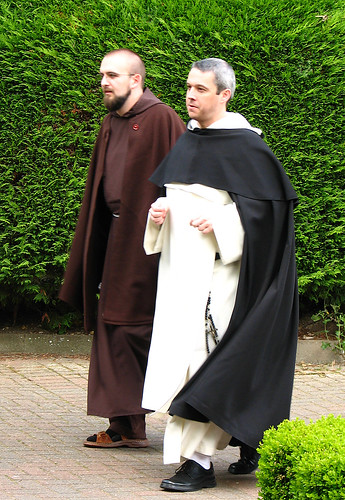
Usually around Homecoming each year, for some reason I come in contact with an Aquinas Yearbook. I know, an Aquinas yearbook itself sounds foreign enough, but the novelty of the experience is the certain atmosphere found between the covers.Some time ago, Aquinas was a different place. The pages evidence classrooms filled with students taught by Dominican friars clad in white robes tied with rosaries. In each yearbook, certain significance is given to a yearly crowning of the Marian shrine. And graduation was celebrated in the second floor of the Fieldhouse, now known as Bukowski Chapel. Student life was different in many respects.

Though certainly things change with growth and the past usually gives way to the future, it is hard to ignore the somewhat atmospheric change which is occurring at Aquinas, and numerous other Catholic colleges throughout the United States, due to the dwindling amount of vowed religious belonging to orders such as the Dominicans, Franciscans and Jesuits.

These numbers reached their apex in the early 1960s and began to fall through the completion of the Second Vatican Council in 1965.

The College’s question of identity sitting ominously in the distance is what will happen with Aquinas College if the Marywood Dominicans cease to provide a religious presence to the campus? Can the Dominican tradition be preserved without Dominicans? And if so, how?

Although it is possible to support the traditions and values of an absent religious order, it seems that the efforts of a Catholic College would be futile if they are not supported directly by the Church, whether through the diocese or religious order. To be Catholic means to be supported and to support; there’s nothing Catholic about a rogue college.

Other Catholic colleges and universities are addressing similar issues. Georgetown University’s resident religious community has shrunk from 100 in 1966 to 60 this year. Searching collegiate newspapers, it is easy to find editorials asking, “Are we Catholic?” As Scott Appleby, a professor of history from the University of Notre Dame, noted, there seems to be “a crisis looming within American Catholic higher education.”

Following the dramatic pause, also insisted by Appleby, he prescribes three steps to regain the beginnings of hope for American Catholic administrators. Appleby recommends that institutional leaders “stay the course, continue to adjust the course and be good to one another.”

I am so glad he didn’t recommend trying to single-handedly fix the vocations problem, overturning the Church’s mandate of celibacy to increase the number of priests or simply ignoring the impending situation. Realistically if we have any type of faith, most of the answers to these problems will not come from our end of the spiritual correspondence.

Along the lines of staying and adjusting the course, we must know what our course headings currently point toward. Aquinas supports a thriving Campus Ministry Department, philosophy and theology majors, a Catholic studies minor, theology as a general education requirement, a Catholic Studies Club and on-campus liturgies.

These facts evidence Aquinas’ recognition and appreciation of the Catholic tradition, and numerous other campus clubs and activities confirm the student support for such values.

Then, how can the College solidify and empower existing programs and activities to enrich the greater Aquinas community, whether Catholic or not? I humbly suggest perhaps filling the room for growth in the philosophy and/or theology departments and strongly considering the importance of a resident chaplain. I’m sure that my peers have other suggestions.

Whatever the answer happens to be, our idea of a Catholic University cannot merely cater to Catholics, and similarly the Catholic Church must enter, though sometimes apprehensively, the outside world. To paraphrase Donald W. Wuerl Archbishop of Washington, the truly Catholic university should work to nurture respect in its interactions, while in its actions remain faithful to its heritage and traditions.

I doubt the answer to the problem will involve either building walls or relativizing distinctions, but I hope (whatever it is) we can bring everyone along.

(Published in Nov. 19 edition of The Saint)

Wednesday, November 12, 2008

Open Question

I'd like to hold a modest experiment. If people participate, this could be interesting.

What are the challenges that a Christian faces in relating to this world, this time in history?

Please, comment at your leisure.

Wednesday, October 1, 2008

Voting Catholic, frustrated


For Catholics, the process of voting should not be simple, and it's even worse if you're voting absentee. Casting a vote is simple-just punching a card. Leading up to the card, however, the voting process asks much of the Catholic. (Although this is ideally both, this term means more broadly "catholically minded," instead of sacramentally formed.)

It would be easier if the Church or the Pope would tell everyone which candidate gets the "Catholic vote." Thankfully, this is not how the Church works.

The process would be simpler if Catholics were able to be simple-issue voters. Perhaps, a single issue could consume the whole of their political and ethical decision, irrespective of the totality of their choice. On this subject, the Vatican's Congregation of the Doctrine of the Faith writes, "a political commitment to a single isolated aspect of the Church's social doctrine does not exhaust one's responsibility towards the common good."

An even easier situation would be if Catholics could simply give the finger to the whole political establishment, saying, "You have done nothing for us; your game is not fair, and we want out."

Catholics can do none of the above. They are "bound to promote the true common good" through "civil authority and laws that uphold moral precepts for the common good," which should constitute an autonomous decision informed by rational scrutiny applied to possible choices. In other words, Catholics can neither hide in political idleness nor in ideaological closures to the reality of affairs.

From their point of view, no candidate seems good enough. In the Bush-Gore election, Gore was ahead by three percent with Catholics. Then in 2004, Bush led among Catholics by seven percent to Catholic John Kerry. Currently, McCain leads among white non-Hispanic Catholics 48 to 41 percent.

Simply put, the Church's teaching does not line up with either party. On one hand, the Church cherishes the right to life, especially unborn life. But also, the Church respects the dignity of the human person, the social implications to avoid war, the responsibility to help the poor and the regulation of working conditions, whether on a personal scale or to the economy as a whole. The Catholic should work for all these things and, when necessary, must seemingly choose one or the other.

Catholic morality says quite candidly, it is wrong to support a candidate or law which entail an intrinsic evil "opposed to the authentic good of persons" such as abortion, euthanasia, torture, racism and ignoring the "moral imperative to respond to the needs of our neighbors."

When both candidates support such a policy the Catholic "may decide to vote for the candidate deemed less likely to advance such a morally flawed position and more likely to pursue other authentic human goods." Whether Catholic voters realize it or not, most recent presidential elections fall into this category.

This is what makes Catholics want to write in their dog's name on the ballot. This is why politics seems like a badly formed game. To have to choose the rights of an unborn child over the rights of an innocent victim of an unjust war, is unfair, to say the least.

Not only does the power to participate in the formation of government implicate the Catholic in the direct effects of his or her choice, whether war or peace, prosperity or hardship, but the choice should come from an authentically formed auto-nomy (self-law) and should be an expression of a certain amount of wrestling with issues, candidates and God.

Catholics who vote should go to sleep on the Third of November with some sense of peace, knowing that their decision is neither uninformed nor narrowly informed by one issue. That peace, however, should not overshadow the clear dissonance which is evident when the idealist hope of faith enter the realm of politics.

Monday, August 25, 2008

A mentionable thought


It is a luxury of the academic world to be able to have "cocktail conversations" about life, love and other questions that usually, as Tennyson wrote, "rust unburnish'd" without timely buffing and rumination.

These big questions of a higher nature are not detached from the truth of our lives, our daily preoccupations and scurryings about. Rather these questions, these higher questions begin to augur into the foundation of each "Why?" or "How?".

A few days ago, a friend noted that for once he understood the lyrics to a popular song. I think many of us have had this experience. A popular song with catchy words gets lodged as a constant repeat in your head. The words pass by with the notes, but they don't go quite deep enough for you to think about them, to understand their meaning. Occasionally, however, a well-written phrase may fall between the superficial cracks in you mind, and the depth is astounding.

The particular phrase my friend noted was "live like today never happened before". So, together we considered the possible meanings/implications of such a message.

"I just love the outlook it invites," I said. "It asks the listener to allow each day to be new, unique and inviting."

"Yeah and if you apply it to relationships," my friend responded, "It tells us that we should let each person be who they are, not forcing them to be who they were to us yesterday or the last time we spoke with them. We should approach each interaction expecting to be surprised by the newness of each person."

This is how such conversations usually begin. How they end is sometimes equally gripping.

Once after a conversation, my dialogue partner responded, "I shouldn't say this, but this was like one of those conversations you have when you are high, and you confuse yourself with your own words."

Saturday, July 12, 2008

Virtue and Uncertainty

Around a table with a number of other theology students, as was customary for a Thursday night, we were about begin a discussion. This Thursday night tradition was coming to an end as the school year closed, and for the last week our topic was, the interconnectedness of things. As an example we began with the theological virtues of faith, hope and love.

The first two encyclicals of Pope Benedict XVI curiously concern two of the theological virtues, love and hope. As a prediction, I would expect to see a third encyclical on faith.

Thomas Aquinas found that there was a necessary relationship among the virtues but a certain preeminence given to love (charity). Love, in this sense, enables the virtues. Considering this relationship, hope and faith cannot function, cannot have life, without love. But perhaps pushing further, can we have love without hope or hope without faith? Aquinas would say, no.

Faith (believing in what is not seen), hope (looking forward to what cannot be certain) and love (giving of one's self with no certainty of return) all seem to rest on a lack of certainty. Then when faith is made certain through sight; hope is fulfilled; and the return of love is granted. Likewise, we hope for the return of love and have faith that it will return even when we cannot be sure through sight.

This may all seem confusing, but the sure conclusion (however disconcerting it may be to some) is that being a Christian means being uncertain. It means living in faith when the returns of love are hidden. It means hoping beyond what seems probable. It means loving when faith and hope are all that is left.

It can also enable us to appreciate how much of our lives are build on a lack of certainty. An uncertain-ness that continues to call us to listen, call us to realize that the path may not be visible for us. In this uncertain-ness, however, we can rest knowing that we are cared for by a Loving Hand.

And if we seriously resign ourselves to this Absolute Care, we have no reason to fear uncertainty.

Tuesday, June 24, 2008

Answers and equations


When we begin to think about the current priest situation faced by Catholics in the United States and the Western world in general, it is necessary to consider the various sides of the problem and the implications afforded by the many solutions.

The statistics show that from 1970 to 2007 the number of diocesan priests fell from 36,005 to 27,971. Including religious priest the numbers fall from 59,000 in 1975 to about 41,500 last year.

Listed as causes for the drop are: trends of smaller family sizes; a sexualized culture where celibacy seems like an impossibility; negative views of the priestly ministry following the sexual abuse scandal; a culture that overvalues wealth; the audacity of a lifelong commitment to a single occupation. The one, however, most considered is celibacy.

Parts of the Church clearly call out for a married priesthood. Numerous theologians argue that a married priesthood is the stimulus needed to solve the "number problem". Rev. Donald Cozzens of John Carroll University said in an interview,
I think celibacy is a great gift, and it's wonderful for people who have the grace and the gift and the calling, but it can be a very difficult situation for men who feel called to the priesthood but not to celibacy. Over the past half dozen years, I've asked probably two dozen men if they've ever thought of being priests, and every one of them has said yes, they have thought of it, but then they add, "I really feel also called to the sacrament of marriage, I'd like to be a husband and a father."
Though a consensus concerning celibacy appears far off, the demographic issue will continue to affect the life of the Church. It surprises me, however, how many commentators tip-toe around the main question. Why? More specifically, what are the underlying foundations for arguments on both sides?

The approach which values both tradition and the status-quo states that a male-celibate priesthood is the proper order given to the Church. Relying on centuries of precedence the reasoning holds well. Even though the celibacy of the clergy is not dogma, and can change, there are theological knots to untie with a married priesthood.

If the priest's vocation is to be one person for many, and a married person's vocation is to be one person for his or her spouse, the lines cross quite clearly in a married priesthood. Can a man give himself totally to a spouse and at the same time give himself to a priestly ministry? If the love of a priest is to mirror the love of Jesus Christ in an analogous way, as one for many, is a married priesthood adding insult to injury when priests are currently overworked and suffering burnout?

The second approach which calls for change does so in clear response to a certain more contemporary phenomenon. The obvious drop in numbers presents a clear dilemma and has been mentioned already.

Without denigrating the gravity of this situation, a few things should be understood. First, priest shortages have happened previously; this is not the first, and this will not be the last. Although distinct historical circumstances should be considered distinctively, the Church should not be quick to throw out the baby with the bathwater due to a singular event.

Second, and perhaps more weighty, to what extent should an issue such as priestly celibacy be an answer to a simple numbers problem, a pragmatic answer? Should the Church immediately change because she is faced with a problem? Inundated with such ideas as natural selection, we hastily choose adaptation for survival over hope in order.

Arguing against pragmatism in Church politics can go either way. My hope for the Church is for Hope. The celibate priest may be a symbol of something quite foreign now in the days following a sexual abuse scandal and in the midst of a highly sexualized culture, but the impetus for change cannot be merely a survival ploy or a number crunch. If we change our understanding of the priesthood it must be for the good of a Church that is everywhere, that is past, present and future.

Sunday, June 15, 2008

To be free

As Christians and People of God, one of the goals of spirituality is freedom. We seek to be free from poverty, free from oppression, freedom from the forces in society that turn us away from God and the good found in others. We seek freedom from our carnality and pure emotionality that is irreverent of the providential goodness of God. Paul writes, we seek to be free from the slavery of sin and fear of death (Rom 7:14; Heb 2:15).

Freedom is by all means an important thematic element in the spiritual journey, but are their currents within Christianity and culture that view freedom as absolute, freedom idolized perhaps?

Sadly, yes. Most clearly in culture, freedom has become synonymous with whimsy and caprice. The free person is the self creating person, the person who seemingly floats free of influence and heeds the call of no one. The free man can say what he wants, without considering the reception of others. The free man can become what he wants, without care of who is taken advantage of. The free man is a sort of existential ideal, living in a situation Heidegger calls "fallenness," a hermeneutic employed by Heidegger and espoused by Jean-Paul Sartre which calls each person to realize his responsibility and freedom following the awareness of the "death of God".

Because of the failed Enlightenment project we know that man, in fact, has a deal of limitations. Thus in accord with these limitations man cannot become his own creator. For instance. human rationality has a limit, and in the face of this limit, the conception of man seems intuitively inadequate. Or considering the various instincts and emotive influences that man is forced to deal with on a daily basis, it is clear that the supposed death of God does not necessitate the responsibility of the self-creating project.

All of these points revolve around the question of the proper use of freedom. Further, the value and proper use of freedom is either an end in itself or freedom is a subordinate end or means to a greater end.

The first possibility endows man with an absolute freedom and equally absolute responsibility that man cannot adequately fulfill and be held responsible for. The previously mentioned self-project cannot be the sole responsibility of the person, if only for the reason that the person did not initiate it. Man is gifted with the prospect of personhood and is so condemned (according to Sartre) to the responsibilities to that personhood.

Rather, freedom to participate in the self-project which was initiated by Someone else must point to a freedom beyond mere whim or caprice, beyond the care of a single person. Freedom is, in a sense, the self-project as participation rather than condemnation. Freedom is a participatory experience. As Karol Wojtyla writes,
Love consists of a commitment which limits one's freedom -- it is a giving of the self, and to give oneself means just that: to limit one's freedom on behalf of the other. Limitation of one's freedom might seem to be something negative and unpleasant, but love makes it a positive, joyful and creative thing. Freedom exists for the sake of love. If freedom is not, is not taken advantage by love it becomes a negative thing and gives human beings a feeling of emptiness and unfulfilment. Love commits freedom and imbues it with that to which the will is naturally attracted -- goodness. (Love and Responsibility, 135)
Freedom ends in love. Perhaps the loving acknowledgment that we are not our own gods; that though we are utterly responsible for our actions, we are not alone in them.